
Year in Review
Dec 28, 2024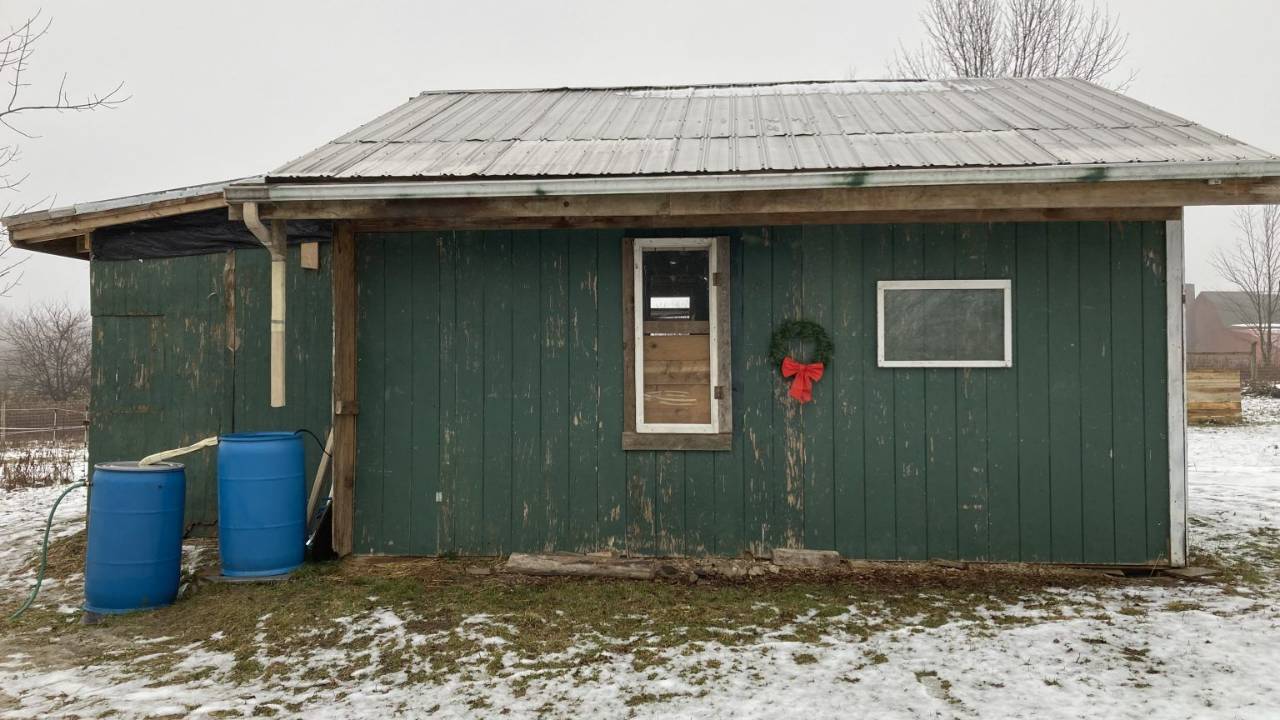
One year ago today we took a big step toward our version of a small farm future (to borrow a phrase from Chris Smaje). Those first few days were filled with insights about the realities of making big transitions. I wrote about them here.
Today I share a brief reflection on what happened over the next twelve months, in the form of a mini-evaluation of our efforts so far. Overriding my tendency to focus on what needs improvement, I’m going to start with the good stuff.
What Went Well
We didn’t quit. Despite wanting to give up at times, we’re still at it. Every single day for the past year—in (Fahrenheit) temperatures roughly paralleling the ages of kids to whom Nat King Cole offers his simple Christmas phrase—we’ve watered, fed, moved, and otherwise tended to the creatures entrusted to our care. I count that as a win!
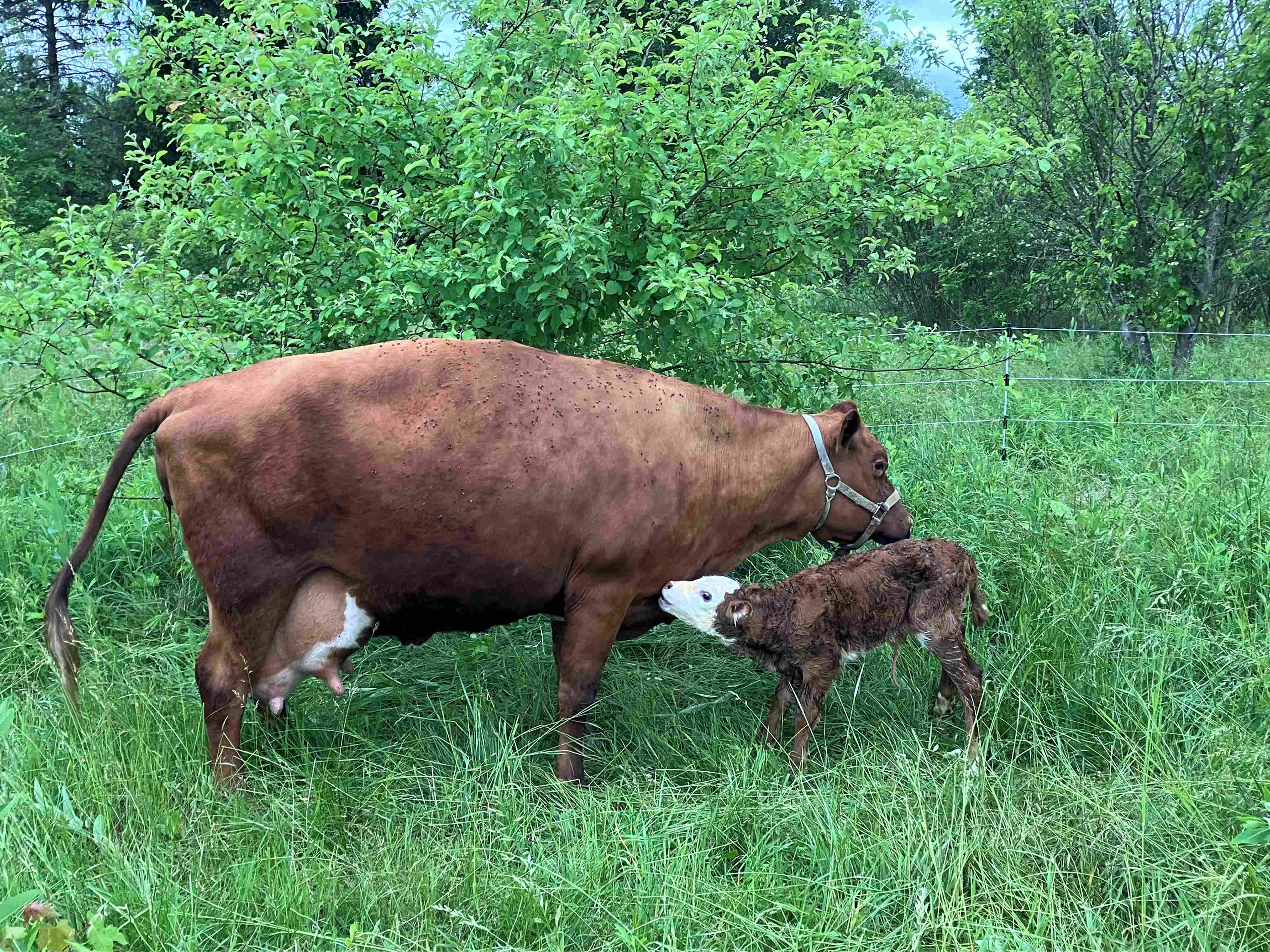
Our tiny herd has grown. On May 27, in the 30 minutes between the time I left the farm after finishing chores and when Tim and the kids stopped by on their way home from a weekend in PA, a healthy bull-calf had been born. When I came back to see him, the sheep were munching nonchalantly in the southwest corner of the paddock while he wobbled in circles around mama.
The animals are doing well. Everyone’s thriving on the diverse mix of plants they’re made to eat. Like new parents, we’ve been quick to worry at times, and relieved and gratified to hear the vet and others who know what they’re looking at comment on how vital and healthy they look.
–
We’ve been getting a yield since day one. In keeping with permaculture principle #3, our cooperative efforts with the animals and land have provided us with valuable nutrients from the get go. With the help of her microbial allies, our cow Noelle has daily been transforming ‘grass’ (shorthand for grasses + a wide variety of pasture plants), which we can’t eat, into food that can nourish us as well as her calf.
It wasn’t all our grass. We’re supplementing with hay, and feeding it solely in winter. Still, it’s been exciting to see the theory in practice. On a little piece of land not yet ready to yield the variety of fruits and vegetables and other resources it eventually could, one lactating ruminant has provided hundreds of gallons of fresh milk and with that a steady supply of yogurt, cream, butter, and cheeses.
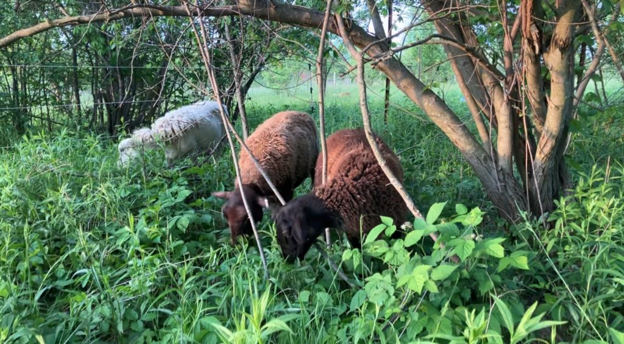
The land is improving.* If you were to visit the summer before, you might conclude that we were excellent growers of poison ivy, multiflora rose, Canada goldenrod, and autumn olive. We had bumper crops of all of them. But in just the six or so warmer months of active rotational grazing so far, we’ve already seen the nibbling of our ovine and bovine partners diminish those populations, making way for more desirable plants (i.e., plants which feed the animals that feed us and the land ongoingly). A win-win. So, despite drought conditions that hindered grass growth, the even distribution of their nutrient deposits and the little water-holding pockets their hooves left behind during wetter weather are having a noticeable positive impact.
[*Improving is a relative term. We’re talking here about the greater capacity for human food production while simultaneously enhancing the health of “the land”—in Aldo Leopold’s terms, the soils, waters, plants, and animals of a place. There are several specific indicators we’d like to track in the coming years, but so far we’re encouraged by what we’re seeing.]
We keep learning. Every week brings new lessons. Unfortunately, mistakes and failures really are some of the most effective. Once you’ve accidentally reeled in a length of polytwine around the handle instead of the spool, for example, you’re highly motivated to never do it again. Thankfully there are also more pleasant ways to learn, like our encounters with experienced folks which almost always leave us with helpful tips, and the occasional affirmation that we’re doing something right.
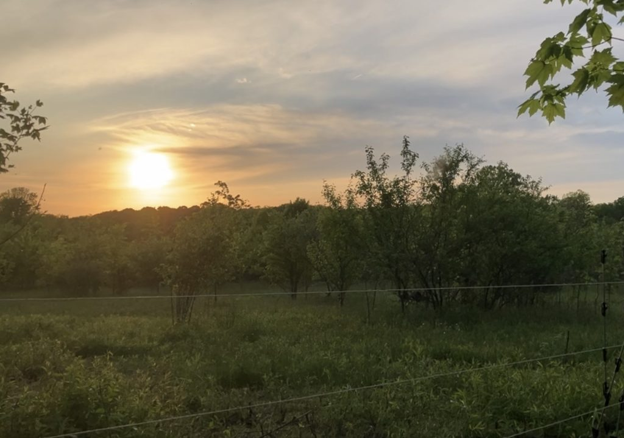
Sunsets! Our house sits on the eastern and downward side of a gentle slope, with tall trees at the top of the hill to the west. It’s perfect for a gravity-fed water system, but not so great for watching the sun go down. As a girl from the plains of Wisconsin, where we had an unobstructed view of sunrises and sunsets, I’ve missed the latter terribly. One of the gifts of our smallholding venture is a front row seat at this nightly show.
What Didn’t Go Well
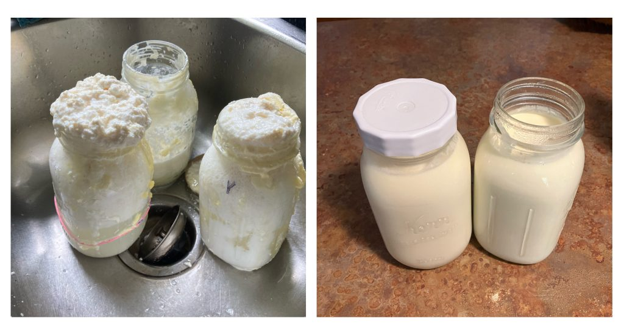
Remember the part about learning from failure? I thought you might get a kick out of seeing an early epic yogurt fail (probably a combination of yeast from the air and being left to ferment too long). It was followed a few days later by delicious success.
OK. Back to business.
We’ve been slow to get key systems in place. Despite best laid plans, somehow we’re still hauling water in 5-gallon buckets. And we haven’t yet set up an alternate cow lane (the path Noelle walks to the barn for milking) on higher ground to use in wet periods. There are a few other such items we can’t check off our list. Not a huge deal, but we could do better.
We didn’t establish the research baselines we intended to. Our plans with biology faculty to test soil life diversity and carbon sequestering capacity, among other things, fell through with their unexpected retirement and departure.
We’ve not done a great job of integrating the farm into our kids’ lives. You know how it’s more work to have kids help with the cleaning and cooking? At least at first. But it’s also the only way for them to learn. We’ve been pretty good about that, but haven’t applied the same logic to farm activities. In our desire to ease the kids into it gradually, I think we’ve made it too easy for them not to be involved.
In the process, I’ve come to appreciate the advice I’ve often heard about the need to make deliberate family lifestyle choices. On top of the challenges of doing this while holding down jobs, it feels nearly impossible to maintain a homesteading life (as I envision it) and be a soccer or band (or whatever) family. Part of what’s been holding us back on this front is that Tim and I see things differently, which brings us to the next point.
We’ve wasted a lot of time and energy disagreeing. More than learning new skills or even physical injuries, the biggest hurdle for us has been certain fundamental differences in our m.o.’s. Whatever else we’ve learned over the years about our opposing tendencies, this past year has brought them all to the forefront. Being more proactive in anticipating and working with those would have saved us some headaches and heartaches.
What We Will Do Differently
Although we can’t go back in time and get this whole thing going earlier, there are a few practical things we will do better in the coming year.
Plan more effectively and execute on our plans. Doing this mostly depends on the next point.
Devote more attention to adjusting the human elements in this system. We both agree that more deliberate efforts to work on our own habits and attitudes will reduce friction and make for a smoother way forward. In particular, we see the importance of more explicitly establishing common values and goals and honing our communication skills.
Stop comparing ourselves with others. Roosevelt was right; comparison really is the thief of joy. People’s circumstances and experience levels vary. The best (and only) place to start is where you are with what you’ve got. We’re working on not only accepting that, but embracing it.
Collaborate to set up long-term studies. There are several things we’d love to be able to measure over time. We’ve recently met a few people who are interested in working with us, so we’ll be exploring those possibilities soon.
Involve family, students, and community more. I still consider us total novices with endlessly more to learn. At the same time, like other one year-olds, we’re excited to be walking on our own two feet. We’re feeling ready to invite others into this venture in a bigger way. After all, that’s central to our main objectives. So, we’re taking steps in that direction. This summer we’ll have some interns and will be hosting one of the College’s week-long themed summer camps.
Wrapping Up
Closing thoughts from Tim
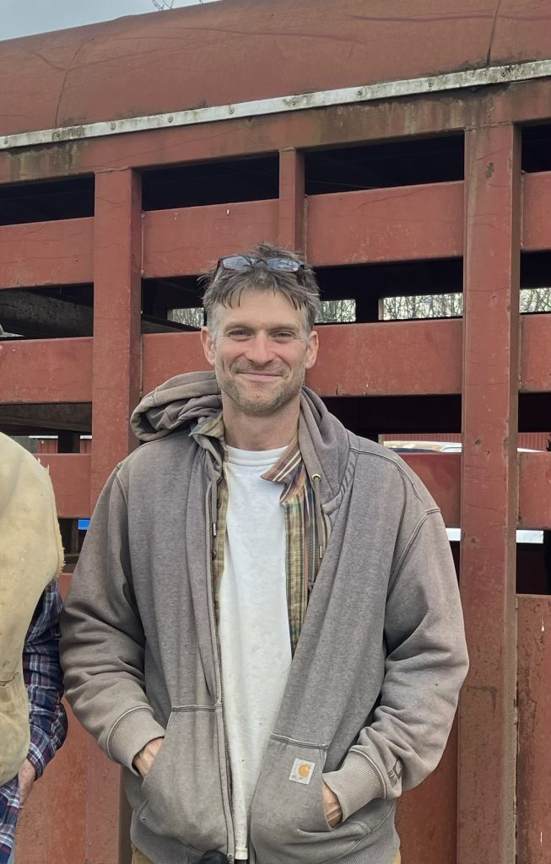
“If you want to make new things happen, you have to take risks and don’t let fear hold you back.”
The other day while milking, it hit him.
He had a few days off and didn’t relish the thought of heading out that morning.
Upon getting started, he was amused to realize, in stark contrast with last December, how much comfort and delight he now takes in the sight and sounds of our cow and spending time with her.
“Things you were once afraid of can become things you love.“
On Transformation
From aversion to affection. Of self and relationships. Of normal and culture. As interested as I am in the biological, ecological, and other material aspects of this work, this is the sort of thing I find myself most often contemplating.
Maybe it’s the sociologist in me. Or maybe it’s because this is where most of us seem to need a lot of help. For people aspiring to something different, these kinds of challenges can be even more fundamental stumbling blocks than lack of resources or skills.
I’m ever grateful for the many excellent practical resources out there. Goodness knows we’d be lost without them! One thing this year has repeatedly shown us is that, for best results, we need both kinds of support. Time and again, it has confirmed my observation that:
“In addition to whatever technical, infrastructural, and informational preparations we should have underway, we need, at the same time, to be developing ourselves in particular and interrelated ways—our bodies, minds, and spirits.”
And with this, our little retrospective ends on a prospective note. In this season of resolutions, the development alluded to above gives us a lot to work with. (At least that’s certainly the case for me!)
On that note, wishing you happiness and health in the new year!
Pictured at the top is the small initial barn Tim built out of parts from a much larger one he offered to take down in lieu of the demo and burning its owners had planned.